
Does ChatGPT Traffic Convert?
Updated: Sep 4
What 164 Million Purchases Reveal About AI Search Demand
A research-led analysis of where ChatGPT referrals convert, where economic value remains weak, and what evidence should precede investment.
YNALIZE Research
Evidence reviewed 24 August 2026
A large first-party commerce study finds that ChatGPT referrals can convert - but commercial value still depends on order economics, attribution, and scale.
Attribution boundary. Kaiser & Schulze (2026) are the source of the reported data, analyses, and study limitations. YNALIZE is responsible for the interpretation, AI Referral Monetization Ladder, Decision Boundaries, and management scenarios. No researcher endorsement is implied.
Executive Answer
ChatGPT referral traffic is becoming commercially observable, but it is not yet economically comparable with mature acquisition channels. In the most rigorous large-sample evidence currently available, ChatGPT sent fewer than 0.2% of sessions to the studied commerce sites. Its visitors converted better than paid-social visitors, but revenue per session remained below every traditional channel except paid social. The strategic implication is not that AI referrals should be ignored. It is that visibility is an early signal, not an investment case.
YNALIZE’s decision rule is therefore simple: do not move from attention to budget until the evidence crosses a sequence of boundaries - qualified visits, conversion, order value, revenue per visit, and repeatable economic scale. The study shows where that sequence currently breaks, where it looks more promising, and what a company must measure before treating AI search as a growth channel.
Why AI Visibility Is Not Yet Commercial Demand
The market is learning to count AI citations, answer visibility, prompt coverage, and referral sessions. These measures matter because they reveal whether a brand enters an emerging discovery environment. But they do not answer the commercial question: does exposure produce customers at an attractive level of value and scale? A brand can be frequently named by an assistant while receiving little traffic. It can receive qualified-looking visits that do not purchase. It can convert buyers whose baskets are too small to support acquisition costs. It can also create value upstream that last-click analytics never assigns to the AI interaction.
This is the same distinction YNALIZE applies to search demand more broadly: volume measures attention; demand quality measures viability. AI visibility belongs near the beginning of the evidence chain. Commercial demand appears only when observed behavior supports an economic decision. The useful management question is not “Are we visible in ChatGPT?” It is “What must be true before that visibility justifies action?”

Figure 1. AI Visibility Is Not the Same as Commercial Value. Original YNALIZE conceptual decision framework.
Related YNALIZE analysis: YNALIZE Methodology | From Keywords to Decision States
What the Study Measured
Maximilian Kaiser and Christian Schulze analyzed first-party commerce data supplied by Grips Intelligence. The full twelve-month window ran from 28 July 2024 to 2 August 2025 and covered 973 websites, 10.51 billion sessions, $20.60 billion in revenue, 164.88 million total transactions, and 50,251 transactions attributed to ChatGPT referrals. The paper uses “oLLM” in its main analysis to refer specifically to traffic from ChatGPT referrals; other LLM platforms are examined separately in a robustness check.
The paper’s principal channel regressions use the six-month window from 2 February to 2 August 2025, when ChatGPT referral volumes were less sparse. That window contained 6.01 billion sessions, $11.49 billion in revenue, 92.83 million transactions, 4.15 million ChatGPT referral sessions, and 44,437 ChatGPT referral transactions. ChatGPT was compared with organic search, paid search, direct, referral, email, affiliate, paid social, and an “other” category.
The outcome set was unusually decision-relevant: conversion rate, average order value, revenue per session, bounce rate, page views, and session duration. The models also examined changes over time and explored whether website-category product complexity and visitor proficiency proxies altered the channel comparison. The researchers repeatedly describe the evidence as observational and descriptive. It compares outcomes; it does not identify the causal effect of a ChatGPT referral.
Source: Kaiser & Schulze (2026) Study companion and additional materials: organicLLM.org
What the Data Shows
The strongest result is the gap between growth and scale. During the main six-month period, ChatGPT referrals generated about 4.1 million sessions and $6.1 million in revenue. Paid search generated roughly 1.53 billion sessions and $3.19 billion; organic search generated 1.43 billion sessions and $2.60 billion; direct generated 1.27 billion sessions and $2.70 billion. ChatGPT traffic represented less than 0.2% of all observed sessions and was about 200 times smaller than Google organic traffic. The channel was measurable, but economically peripheral in the aggregate.
Conversion quality was more encouraging than the scale numbers. After accounting for the paper’s controls and weighting, paid-social visitors were estimated to have 53% lower conversion likelihood than ChatGPT-referred visitors. Organic-search visitors were estimated to have 13% higher conversion likelihood, while affiliate visitors were 86% higher. Across robustness checks, the central pattern held: ChatGPT’s conversion rate generally exceeded paid social but trailed the remaining traditional channels. The difference from organic search was less stable than the broad headline; it became statistically nonsignificant in several specifications.
Average order value was not a simple story of AI shoppers buying less than everyone else. Confidence intervals were wide and only four of eight channel differences were statistically significant in the main model. Affiliate orders were about $24.70 larger than ChatGPT-referred orders, while differences from organic search, paid search, paid social, and the “other” category were not statistically significant. This matters because a weak or imprecise AOV comparison should not be turned into a universal claim about AI-referred customer value.
Revenue per session - the most useful combined measure in the paper - placed ChatGPT above paid social but significantly below every other traditional channel. Engagement was similarly mixed. ChatGPT referrals had a relatively favorable bounce rate against several channels, yet produced fewer page views than every channel except paid social. Session duration was far ahead of paid social and comparable with affiliate and direct traffic. The pattern resembles focused but not yet fully monetized visits: visitors may arrive with a specific answer or product in mind, browse less, and still fail to generate mature-channel economics.
Source: Kaiser & Schulze (2026)
Growth Rate vs. Economic Significance
Across the twelve-month observation period, ChatGPT-referred conversion rate and revenue per session improved. Average order value declined, partially offsetting conversion gains. The researchers’ time models generally suggest that conversion could move closer to organic search, but most do not project parity within the following twelve months. For revenue per session, the other three model specifications do not project convergence within that horizon; only the most aggressive linear specification reaches parity.
Those projections are model-based illustrations, not promises. Interfaces, consumer behavior, merchant integration, referral identification, and advertising formats can all change. The management error would be to treat a high growth rate from a tiny base as evidence of current materiality. Growth changes the priority of measurement. Economic significance changes the priority of capital.
Source: Kaiser & Schulze (2026)
Where AI Referrals Look More Promising
The paper’s exploratory category analysis points to a plausible decision condition: AI referrals may matter sooner where purchases require more explanation, comparison, or configuration. Websites in high-complexity categories had 4.6 times the organic LLM traffic share of low-complexity sites. The high-complexity group included categories such as heavy industry and engineering, vehicles, finance, law and government, jobs and careers, and business or consumer services.
Within those categories, ChatGPT-referred conversion exceeded paid social, referral, email, organic search, and direct traffic; average-order-value gaps narrowed; and revenue per session moved closer to organic and paid channels. Separate website-level proxies for technophile and younger audiences also showed larger AI-referral shares, with some more favorable conversion comparisons.
These results are promising, not causal segmentation rules. Complexity was classified at the website-category level by multiple LLMs, not measured for each product or purchase journey. Conversion types may differ across categories, and visitor characteristics were inferred through website-level proxies. YNALIZE would use the result to prioritize tests - not to declare complex products universally “better” for AI acquisition.
Source: Kaiser & Schulze (2026)
The AI Referral Monetization Ladder
YNALIZE’s AI Referral Monetization Ladder translates the paper into seven successive evidence states. The framework is original to YNALIZE; it is not proposed by Kaiser and Schulze. Each stage resolves one uncertainty while leaving the next one open.

Figure 2. YNALIZE AI Referral Monetization Ladder. Original YNALIZE framework informed by the research; not proposed or endorsed by the study authors.
1. AI Visibility. The brand or product appears in AI-generated answers. This tells management that the entity is discoverable in a new interface. It does not show whether users click, qualify, buy, or create value. The next condition is observable referral behavior from a sufficiently reliable source taxonomy.
2. Referral Visit. An AI source sends a measurable session. This proves movement from answer exposure to a property the company controls. It does not prove intent or incremental influence. The next condition is evidence that visits reach relevant categories, products, or decision-stage content.
3. Intent and Visit Quality. Visitors exhibit behavior consistent with a commercial task: relevant landing-page entry, low immediate abandonment, meaningful product interaction, or progression toward checkout. Engagement alone is not revenue. The next condition is a conversion rate that is stable enough to compare with an appropriate benchmark.
4. Conversion. A defined commercial outcome occurs. This shows that AI-referred demand can complete the chosen action. It does not show whether the basket, margin, customer mix, or attribution is attractive. The next condition is sufficient order or outcome value.
5. Average Order Value. Converted visits create baskets of an economically meaningful size. AOV does not account for how rarely purchases occur or how costly the channel is to develop. The next condition is an acceptable revenue-per-session or value-per-visit result.
6. Revenue per Visit. Conversion probability and order value combine into a channel-level productivity measure. This is stronger evidence than traffic, conversion, or AOV alone. It still does not establish contribution margin, incrementality, durability, or volume. The next condition is repeated performance under the company’s unit economics.
7. Scalable Economic Value. The channel produces repeatable, incremental contribution at meaningful volume and acceptable risk. Only here does AI referral performance become a budget-allocation case. Scale must survive changes in prompts, models, interfaces, attribution rules, and competitive participation.
From Visibility to Visits to Value to Scale
The ladder prevents a common analytical shortcut: using evidence from one stage to make a decision that belongs to a later stage. Citation growth can justify measurement infrastructure. Referral growth can justify a landing-page or category test. Strong conversion can justify an order-value investigation. Attractive revenue per session can justify contribution-margin and incrementality work. None of those intermediate signals independently authorizes broad channel investment.
This sequencing also explains why the study is both encouraging and cautionary. ChatGPT has crossed the observability boundary and, for many merchants, the qualified-visit boundary. It shows credible conversion behavior and comparatively strong results against paid social. But its aggregate revenue productivity and scale remain below mature channels. The evidence supports structured experimentation and sharper attribution - not a general reallocation of acquisition budgets.
Decision Boundaries for AI Referral Investment
A decision boundary states what evidence must be present before the next action is justified. At the visibility boundary, the firm needs stable and relevant presence across a defined prompt set; failure means discovery is too sporadic to manage, so the implication is observe and diagnose. At the intent boundary, it needs identified referral sessions reaching commercially relevant destinations; failure means visibility is not translating into qualified visits, so improve measurement before changing spend.
At the conversion boundary, the firm needs a pre-specified commercial outcome, a credible comparator, and enough observations to bound uncertainty. Failure means engagement cannot be valued, so run targeted experiments rather than extrapolate. At the value boundary, conversion must produce acceptable order value, revenue per visit, and preferably contribution margin; failure means the traffic may convert but not support the business model. At the scale boundary, performance must repeat at meaningful volume without collapsing under cost, attribution, or interface changes. Failure means keep the channel in an option-testing portfolio rather than a core plan.
Related YNALIZE analysis: The Decision Boundary Framework
What the Research Does Not Prove
First, it does not prove that ChatGPT causes the observed outcomes. People who use ChatGPT, the products they research, the websites they select, and the situations that prompt them to click can all differ from users arriving through other channels. Controls improve comparability but cannot remove unobserved selection.
Second, last-click attribution cannot capture the full path. An AI answer may create awareness or narrow a shortlist before a later branded search, direct visit, retail purchase, or app conversion. The paper explicitly identifies this limitation. It means observed referrals may understate upper-funnel influence, but it does not license a marketer to claim unmeasured value. That value must be tested with multi-touch analysis, controlled experiments, or carefully designed journey research.
Third, category and audience findings are exploratory. Product complexity is a website-category proxy, and consumer proficiency is inferred from aggregate website characteristics. The analysis cannot simultaneously identify product-level complexity, individual customer traits, and channel effects. Differences may also reflect category-specific definitions of conversion.
Fourth, the environment is moving quickly. The data end on 2 August 2025. Model behavior, browser and shopping integrations, citation patterns, merchant feeds, checkout experiences, advertising, and user skill can change the economics. A historical benchmark is valuable, but it is not a current universal rate card.
Finally, revenue is not profit. The study does not supply each merchant’s gross margin, content or technical investment, support burden, returns, new-customer value, or lifetime value. Revenue per session is a powerful bridge metric, but a company must add its own economics before making a capital decision.
Source: Kaiser & Schulze (2026)
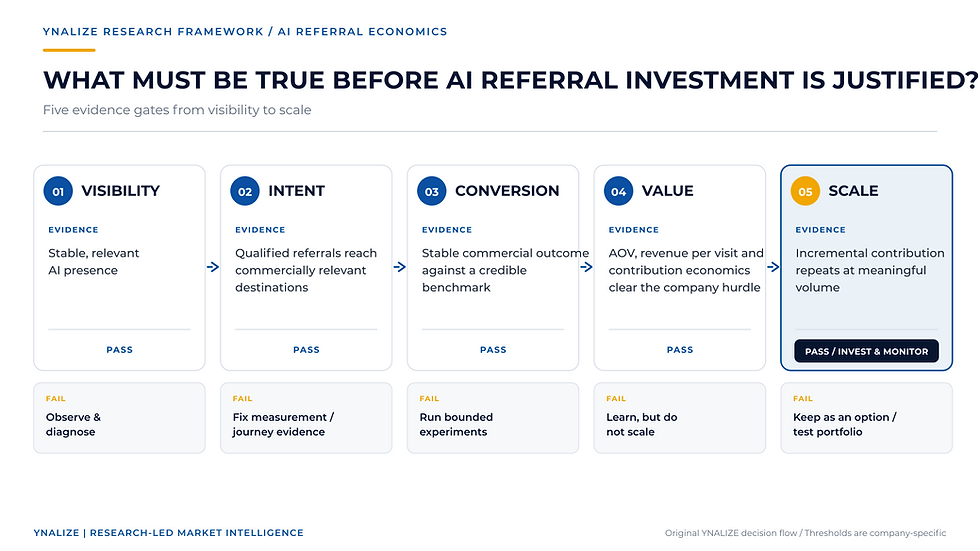
Figure 3. AI Referral Decision Boundaries. Original YNALIZE decision flow; thresholds are company-specific.
Three Scenarios for Management
These are YNALIZE scenarios, not forecasts from the researchers.
Conservative: AI referrals remain a small discovery layer. Traffic grows but stays immaterial; last-click performance remains below established channels. The justified action is to maintain clean attribution, monitor prompt and category coverage, and avoid material budget reallocation. Evidence that would change the decision includes sustained qualified volume, credible assisted-conversion impact, or a category-specific value advantage.
Realistic: AI referrals become meaningful in selected complex or research-intensive journeys. A few categories cross conversion and value boundaries while the aggregate channel remains small. The justified action is a bounded test portfolio: category-level landing paths, feed and content quality experiments, cohort analysis, and contribution-based thresholds. Investment expands only where repeatability appears.
Aggressive: AI interfaces become a substantial acquisition layer through deeper shopping integration, higher user proficiency, and easier transaction completion. Referral volumes and revenue productivity approach mature channels. The justified action is scaled investment - but only after the company verifies incremental contribution, resilience across model and interface changes, and acceptable concentration risk. High market growth alone is not the trigger.
What Companies Should Measure Now
Start with measurement integrity. Define the referral taxonomy, preserve referrer and campaign parameters where available, separate ChatGPT from other LLM sources, document dark or unclassified traffic, and retain the model and date context. Report sessions, share, and growth, but show absolute volume beside every rate.
Then measure progression through the ladder: landing destination and content category; bounce and meaningful interaction; product or pricing-page progression; conversion rate with sample size and uncertainty; average order value; revenue per session; and gross margin or contribution per session. Separate new from returning customers and, where possible, estimate retention, repeat purchase, returns, support cost, and lifetime value.
Add the evidence the study cannot provide for an individual company. Compare first-touch, last-touch, and assisted conversions. Analyze branded-search and direct-traffic sequences following AI exposure. Segment by product complexity, price, device, geography, customer status, and decision stage without reading small cells as stable truths. Use holdouts, geo tests, or time-bounded interventions where feasible to estimate incrementality.
Finally, define the boundary before reading the result. State the minimum reliable volume, acceptable conversion range, value-per-visit requirement, contribution hurdle, and repetition period that would justify the next action. Thresholds should come from the company’s economics and alternatives, not from a universal AI benchmark.
YNALIZE Interpretation
The paper does not show that AI referrals are commercially irrelevant. It shows that the market is early enough for visibility and economics to diverge sharply. ChatGPT already sends visitors who can convert, and performance appears stronger in some complex journeys. Yet the aggregate channel still lacks the revenue productivity and scale of most mature sources.
That is a decision-intelligence problem, not a channel-ranking problem. The appropriate response is to preserve the option, improve first-party evidence, and set explicit progression rules. AI visibility becomes strategically valuable when it predicts qualified behavior, survives an economic test, and repeats at scale. Until then, it is a signal to investigate - not a result to celebrate.
Related YNALIZE analysis: When Demand Exists but Revenue Lags | From Data to Decisions
Researcher Perspective
Christian Schulze, Associate Professor of Marketing at Frankfurt School of Finance & Management and co-author of the study, offered his perspective on what would need to change for organic LLM referrals to become commercially significant:
“oLLM will need to improve either in terms of performance (in particular, RPS) and/or in terms of size.”
YNALIZE Note:
This distinction reinforces the importance of evaluating performance and scale separately. Improving revenue per session can strengthen channel economics, while increasing referral volume can strengthen materiality. Commercial significance ultimately depends on whether either - or both - progress sufficiently to cross the relevant decision boundary.
Final Decision Question
If AI referral traffic doubled next quarter, what evidence - beyond the growth rate - would have to be true before your company changed a budget, product, or market decision? If the answer is not defined in advance, the organization is tracking an emerging signal without yet managing its commercial meaning.
References / Sources
Kaiser, M., & Schulze, C. (2026). Frontiers: ChatGPT Referrals to E-Commerce Websites: How Do LLMs Compare Against Traditional Channels? Marketing Science, 45(4), 699-715. https://doi.org/10.1287/mksc.2025.0489
Publisher article record and supplementary materials. https://pubsonline.informs.org/doi/10.1287/mksc.2025.0489
Publisher open-access PDF (CC BY 4.0). https://pubsonline.informs.org/doi/pdf/10.1287/mksc.2025.0489
Organic LLM research companion. https://organicllm.org/
YNALIZE Methodology. https://www.ynalize.com/methodology
YNALIZE Library. https://www.ynalize.com/library


Comments