
How Much Does Market Research Cost in 2026? Pricing, Methods & What You Actually Need
Updated: Sep 3
YNALIZE | 2026 MARKET RESEARCH PRICING GUIDE
Pricing benchmarks, cost drivers and decision-based budgeting

There is no universal market research price in 2026. The same label can describe an internal review of public data, a purchased industry report, ten specialist interviews, a 400-person survey, or a multi-country program combining qualitative and quantitative fieldwork. Public benchmarks therefore stretch from no external cash outlay for DIY secondary research to more than $100,000 for complex multi-country work. [2] [5]
For a practical starting point, public supplier guides place a full-service online survey around $5,000-$15,000+ for roughly 400 completes; 10-15 in-depth interviews around $5,000-$15,000; and a focus group around $5,000-$20,000+ per group when two published benchmarks are considered together. [1] [2] Those are planning ranges, not an industry tariff. A quote can change sharply with the target audience, geography, sample design, interview or survey length, recruitment difficulty, analysis depth, timetable and deliverables.
The more useful budgeting question is not simply, “How cheaply can we obtain research?” It is: what evidence is required to make this decision with an acceptable level of uncertainty? That question keeps the article focused on market research cost—what different methods cost, why prices vary, what different budgets can buy and when spending more is justified—rather than repeating the broader decision-intelligence frameworks already covered in the YNALIZE Research Library.
What Does Market Research Cost in 2026?
The table below combines current, publicly accessible supplier and platform benchmarks. It deliberately preserves disagreements between sources because the disagreement is informative: suppliers often include different samples, markets, incentives, facilities, analysis and reporting in the quoted price.
Research approach | Public 2026 planning benchmark | What the benchmark actually describes | Important limitation |
DIY / public secondary research | $0 external fee to low-thousands in tools or analyst time | Internal analysis using public statistics, search behavior, company information and existing data | “Free” excludes employee time, paid databases and the cost of weak interpretation. [5] |
Purchased syndicated report | $490 single-user access at one specialist provider; $4,500-$8,500 across individual-to-enterprise licenses at another | Access to an existing report, not research designed for your decision | |
Omnibus survey | $2,000-$5,000 for 10-15 questions | Questions placed within a shared national survey | Efficient when the available sample and questionnaire format fit the decision. [2] |
Full-service online survey | $5,000-$15,000+ for about 400 completes; another supplier publishes $5,000-$30,000 for 500-1,500 respondents | Questionnaire design, fieldwork, data processing and some level of analysis | |
In-depth interviews | $5,000-$15,000 for 10-15 interviews; another benchmark is $500-$1,500 per 45-60 minute interview | Recruitment, moderation, transcription and thematic analysis | |
Focus groups | $5,000-$12,000 per group in one guide; $7,000-$20,000+ in another | Recruitment, moderation, incentives and—in some quotes—facility, recording and reporting | |
Phone survey | $15,000-$30,000+ for about 400 completes; $15,000-$50,000 for 300-800 in another regional guide | Interviewer-led survey fieldwork and reporting | |
In-person survey | $20,000-$50,000+ for about 400 completes | Face-to-face collection with staff, travel and site logistics | Location count, permissions, travel and supervision can dominate cost. [1] |
Multi-country custom research | Can exceed $100,000 | Multiple markets, languages, local fieldwork partners and centralized synthesis | Market count alone is insufficient; sample, method and local difficulty determine the program. [2] |
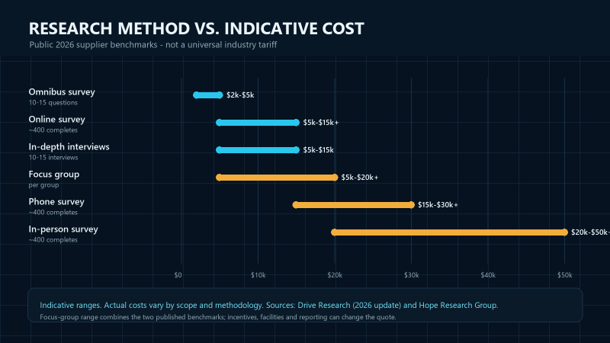
Indicative ranges from public supplier benchmarks. Actual costs vary by scope and methodology.
Why published market research prices differ so dramatically
A $5,000 survey quote and a $30,000 survey quote may not describe comparable work. One may cover programming and panel completes only. The other may include research design, questionnaire development, sample quotas, translations, data-quality checks, weighting, statistical analysis, executive interviews, a presentation and stakeholder workshops. The word “survey” hides the production system behind it.
The same problem appears in qualitative research. A “focus group price” may mean only moderator and fieldwork, or it may include recruitment, incentives, a facility, streaming, recording, transcription, analysis and a decision-ready report. A lower number is not necessarily better value; it may simply exclude more of the work. Conversely, a larger and more polished report is not automatically more useful if the extra analysis cannot change the decision.
For that reason, every proposal should separate four layers: research design, data or fieldwork, analysis and deliverables. Price comparisons become meaningful only after those layers are aligned.
What Determines the Cost of Market Research?
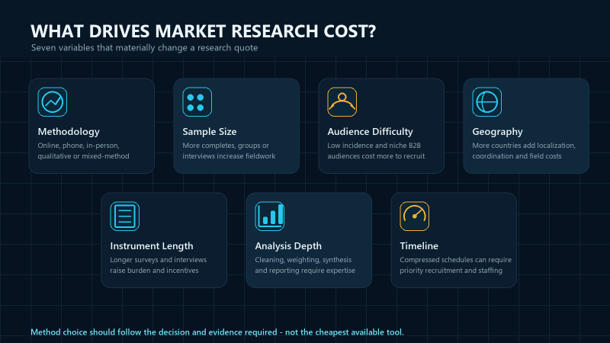
Market research pricing is primarily a design problem. The following variables determine how much labor, field access, specialist judgment and quality control a project requires.
Methodology. Online surveys are usually cheaper to administer than telephone or face-to-face surveys because they require less interviewer labor. AAPOR similarly notes that online surveys can be administered quickly at lower cost, while telephone studies require interviewers and in-person surveys generally cost the most and take longer. [8]
Sample size and sample quality. More completes, interviews or groups increase direct fieldwork and processing. But size is not the only issue. A large convenience sample can be less decision-relevant than a smaller, carefully designed sample. Sampling frame, quotas, weighting, probability versus nonprobability recruitment and the population being represented all affect both cost and credibility. [8]
Audience accessibility and incidence. A general consumer audience is easier to recruit than procurement directors in a narrow industry, specialist physicians or owners of a rare product. Low incidence means screening more people to find each eligible participant, which raises recruitment time, panel fees and incentives. Public supplier guides consistently identify audience difficulty as a major cost driver. [1] [2]
B2B versus B2C. B2B research is not inherently superior, but it is often more expensive because professional audiences are smaller, harder to verify and more costly to compensate. Respondent’s current pay-as-you-go recruitment page, for example, shows $40 per completed moderated B2C session and $80 per B2B session before participant incentives. [4]
Geography and number of markets. Every new country can add sample sourcing, translation, cultural adaptation, local legal review, time-zone coordination and separate analysis. “Global” is therefore not a single scope item; it is a multiplier across the research system.
Survey or interview length. Longer instruments require more participant time, increase dropout risk and usually require larger incentives. They also create more material to clean, code and interpret. A long survey is not automatically more rigorous; it may simply be more burdensome.
Analysis depth and specialist expertise. Basic frequencies and a short topline are less expensive than weighting, segmentation, conjoint analysis, econometric work, multilingual qualitative coding or a strategic synthesis across primary and secondary evidence. The cost is not the slide count. It is the expert time required to turn observations into defensible conclusions.
Timeline and deliverables. Rush recruitment, parallel fieldwork, weekend moderation and compressed review cycles can require additional staffing. At the other end, an over-engineered deliverable - dozens of unused cross-tabs, a large deck, dashboards and workshops - can consume budget without improving the decision.
Primary vs. Secondary Market Research Costs
Secondary research analyzes evidence that already exists: government data, regulatory filings, company reports, published studies, search behavior, pricing pages, trade sources and commercial databases. Its economics are dominated by analyst time, access rights and interpretation. It can be extremely efficient when the decision concerns market structure, visible demand, competitor positioning or a first-pass market screen.
Primary research creates new evidence for a specific question. Surveys, interviews, focus groups, observation and field audits add recruitment, incentives, instrument design, data collection, quality control and analysis. That makes primary research more expensive, but also potentially more relevant when existing evidence cannot answer the question.
AAPOR recommends asking whether timely, relevant data already exist before commissioning a survey and whether another method may be more appropriate. [8] That is good research economics. Primary data should not be purchased merely because it looks more rigorous. It should be purchased when the unresolved question requires evidence that secondary sources cannot provide.
Purchased market research reports sit between the two. They may save substantial time, but they are still secondary research. Current published prices illustrate how wide this category is: Intersect360 lists $490 for single-user access and $2,400 for enterprise-wide use, while Fact.MR lists $4,500 for an individual license, $6,500 for corporate use and $8,500 for enterprise use. [6] [7] The price reflects topic, provider, support and licensing—not automatic fit with your decision.
Agency vs. Consultant vs. DIY vs. AI-Assisted Research
Model | What you are buying | Best fit | Main risk |
DIY | Internal time, direct access to public evidence and full control of the question | Early screening, small reversible decisions, teams with research capability | Confirmation bias, weak sampling, poor question design and uncounted staff time |
Independent consultant | Senior attention and a focused scope with lower organizational overhead | Defined questions requiring judgment, synthesis or specialist expertise | Capacity, continuity and fieldwork resources vary widely |
Research agency | Integrated design, recruitment, fieldwork, quality assurance, analysis and stakeholder delivery | Larger primary studies, multi-method work, complex audiences and decisions needing defensibility | Higher overhead and the temptation to buy deliverables that will not be used |
AI-assisted research | Faster discovery, document review, coding, transcription support, classification and draft synthesis | Accelerating repeatable tasks under human review | False confidence, opaque data provenance, privacy risks and confusing synthetic output with human evidence |
AI can reduce the labor cost of searching, organizing, coding and summarizing. It can help draft a questionnaire, classify open-ended responses, compare competitor claims or identify inconsistencies for a researcher to investigate. It does not automatically solve sampling, participant authenticity, questionnaire validity, field access, causal interpretation or decision accountability.
That distinction is consistent with current professional guidance. AAPOR’s 2026 report on responsible AI integration emphasizes data quality, transparency, human oversight, ethics and disclosure across the survey lifecycle. [9] The Insights Association’s standards require AI-generated data to be distinguished from human-participant data and state that research AI should not operate without human judgment across design, validation and application. [10]
The practical conclusion is balanced: use AI to reduce avoidable production time, but do not use lower production cost as evidence that the underlying research is valid.
What Does a Small Research Budget Actually Buy?
A small budget is most effective when it narrows a question rather than pretending to answer everything. It can fund a structured review of public evidence, one or two specialist report licenses, a limited competitor and pricing analysis, a carefully designed self-service survey, or a small set of customer interviews managed internally.
Self-service platforms make the distinction between data-collection cost and full research cost particularly clear. Prolific currently recommends participant pay of at least $12 per hour and adds a 42.8% platform fee for corporate customers. [3] A 10-minute study with 400 participants would therefore imply $800 in participant rewards and $342.40 in platform fees, or $1,142.40 before VAT, survey software, questionnaire design, data cleaning, analysis and staff time. This is an illustrative calculation from the published rate - not a quote or a full-service market research price.
Small budgets work best for reversible decisions and early falsification: Is there enough evidence to continue? Which assumption is weakest? Which segment deserves a closer look? They work poorly when a business tries to obtain statistically defensible multi-market evidence, senior B2B recruitment and decision-ready analysis for the price of panel access alone.
What Does a Mid-Sized Research Budget Buy?
Public benchmarks place several substantial single-method projects in roughly the $5,000-$30,000 range: an online survey, 10-15 interviews, a focus group, or a regional mixed-method design with constrained scope. [1] [2]
At this level, a buyer can usually expect more methodological support: a research brief, instrument design, professional recruitment, fieldwork management, quality checks, analysis and a concise report. The budget is still finite. Adding niche B2B audiences, multiple countries, translations, complex weighting or several stakeholder workshops can quickly force trade-offs.
The right trade-off is often depth over breadth. One well-defined market and one decision-relevant audience may produce more usable evidence than a shallow study spread across five markets.
What Does a Large Research Budget Buy?
Larger budgets become rational when the research system—not merely the report—must expand. Hope Research Group publishes $25,000-$75,000 for comprehensive quantitative studies and notes that multi-country work can exceed $100,000. [2] That scale can support harder recruitment, multiple markets, larger or more carefully controlled samples, translations, local field partners, mixed methods, advanced analytics and senior synthesis.
The danger is equating scale with insight. More respondents may improve precision under a sound design; more interviews may reveal variation; more markets may test transferability. But none of those automatically produces better judgment. A large program is valuable when the decision genuinely requires those layers of evidence and when the organization has defined how the findings will change action.
How Much Does Market-Entry Research Cost?
Market-entry research cost depends on which uncertainties must be resolved. A focused secondary-led assessment may examine demand, market structure, regulation, pricing, competitors and channel economics using public and licensed data. One current European vendor guide publishes €1,500-€5,000 for freelancer-led work and €5,000-€15,000+ for agency research; those figures are one supplier’s benchmark, not a universal European price. [5]
The budget rises when the decision requires new local evidence: customer interviews, a representative survey, retailer or distributor interviews, store audits, concept testing or validation in several languages. The earlier method benchmarks show why a single-country project with primary research can move into the tens of thousands, while multi-country programs can move beyond $100,000. [1] [2]
The correct market-entry scope begins with a decision: enter, delay, test, partner, localize or reject. The YNALIZE market-entry perspective and methodology treat digital demand, competition and economic reasoning as evidence within that decision context. Primary fieldwork should then be added where the existing evidence leaves a decision-critical gap.
How Much Does Competitor Research Cost?
Competitor analysis can be almost free in external cash terms when it uses public websites, pricing pages, product reviews, search results, filings and marketplace data. It can also become a significant custom-research project when it covers private competitors, multiple countries, customer switching behavior, win-loss interviews, channel checks or specialist databases.
The purchased-report examples - $490 at one specialist provider and $4,500-$8,500 across license levels at another - show the potential cost of one secondary input, not the cost of a complete competitor analysis. [6] [7] The analytical work remains: normalize competitor definitions, distinguish claimed positioning from observed behavior, identify structural advantages and connect findings to the decision.
A useful competitor study does not become better because it includes more competitor profiles. It becomes better when it clarifies what rivals control, what customers value, which barriers are real and whether the proposed strategy can overcome them. Readers who want to inspect the form of a decision-support deliverable can review the verified YNALIZE sample report or the reports catalog.
When Is Expensive Market Research Worth It?
Expensive research is most defensible when four conditions align: the decision has substantial downside exposure, it is difficult to reverse, uncertainty is material, and stronger evidence could change the level or direction of commitment. Country entry, major product repositioning, acquisition strategy, a large growth allocation or a multi-year channel decision may justify stronger research than a landing-page test.
That does not mean every large decision needs the largest possible study. It means the evidence standard should reflect the decision. The Decision Boundary Framework develops this logic in depth: consequential decisions require clearer conditions before action is justified.
When Should You Not Pay for More Market Research?
Do not buy more research when the additional evidence is unlikely to change the decision. Common warning signs include:
1. The team has already decided and wants research only to validate a preferred answer.
2. The decision is small, reversible and cheaper to test directly.
3. Existing data already answer the question with sufficient confidence.
4. The research question is too vague to determine what evidence would count.
5. No decision owner has agreed how different findings would affect action.
6. The cost and delay of research are disproportionate to the downside exposure.
In those cases, a limited experiment may be more informative than another report. Launching a small landing-page test, conducting a handful of targeted interviews, requesting distributor feedback or running a pilot can create behavioral evidence at lower commitment. The goal is not to minimize research. It is to avoid paying for information that cannot improve the decision.
The Cost of Research vs. the Cost of Being Wrong
Research should be evaluated against decision exposure, not against an abstract preference for cheaper reports. A $3,000 research project could be excessive for a decision that exposes a business to only $2,000 of downside. The same $3,000 could be inexpensive if it challenges assumptions behind a $300,000 commitment. These figures are a hypothetical illustration of decision economics - not a market-pricing benchmark.
The value of research depends on whether it changes, validates, narrows, delays or prevents a consequential decision. More expensive research is not automatically better. The correct budget is the least costly research design capable of producing the evidence the decision genuinely requires.
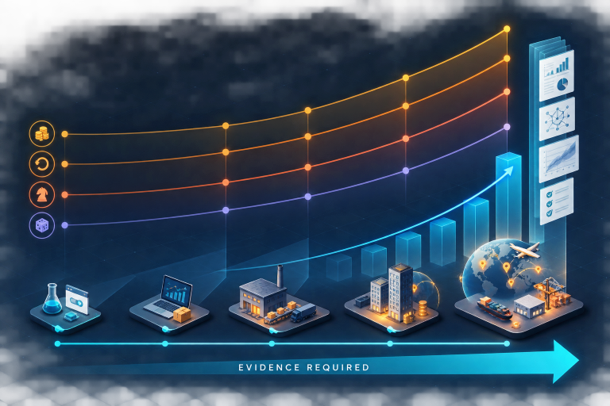
Evidence requirements generally rise with decision exposure, irreversibility, uncertainty and strategic consequence.
Frequently Asked Questions
How much does market research cost?
Market research can require no external cash outlay for internal secondary research, a few hundred to several thousand dollars for platform access or purchased reports, $5,000-$30,000 for many focused full-service studies, and more than $100,000 for complex multi-country programs. [1] [2] [6] [7] The method, audience and deliverable must be specified before the number is meaningful.
Why is market research so expensive?
The expensive components are usually not the raw questions. They are research design, recruitment, participant incentives, interviewer or moderator labor, data-quality controls, translation, analysis and accountable interpretation. Hard-to-reach audiences and multi-market fieldwork add further cost.
How much does a market research agency charge?
Public guides place focused full-service surveys, interviews and focus groups from roughly $5,000 into the tens of thousands, while comprehensive quantitative or multi-country programs can cost substantially more. [1] [2] Ask every agency to separate design, fieldwork, analysis and deliverables.
How much does a market research report cost?
Current public examples range from $490 for single-user access at Intersect360 to $4,500 for an individual Fact.MR license and $8,500 for an enterprise license. [6] [7] These are provider examples, not a universal market range; topic and usage rights matter.
Is primary market research more expensive than secondary research?
Usually, because primary research creates new data and therefore adds recruitment, incentives, instrument design, fieldwork and quality control. Secondary research can still be expensive when it requires specialist databases or extensive analyst time, but it avoids many direct collection costs.
Can AI reduce market research costs?
Yes, AI can reduce time spent on discovery, transcription, classification, coding and draft synthesis. It cannot automatically validate a sample, replace real respondents, establish data provenance or take responsibility for a decision. Current professional guidance emphasizes transparency, validation and human oversight. [9] [10]
How much should a startup spend on market research?
A startup should match the research budget to the next decision and the capital exposed. Early, reversible choices often justify secondary research and small tests. A regulated launch, inventory commitment or country entry may require stronger evidence. There is no responsible fixed percentage that applies to every startup.
Is market research worth the cost?
It is worth the cost when it can materially change a decision, reduce exposure, identify a better segment, reveal a barrier, convert a large commitment into a smaller test or provide enough evidence to proceed. If it cannot affect action, even inexpensive research may have little economic value.
Conclusion: The Right Research Budget Depends on the Decision
There is no universal answer to “How much does market research cost?” A focused desk-research project and a multi-country primary research program can both be called market research while solving fundamentally different problems. Comparing providers on price alone is therefore misleading unless the question, methodology, sample, markets, analysis and deliverables are comparable.
The better contrast is not simply between an inexpensive supplier and an expensive one. It is between two questions:
“How cheaply can we get the research?”
and
“What evidence do we need to make this decision with an acceptable level of uncertainty?”
Limited, reversible decisions may justify limited research. A content test, prototype, small campaign or narrow segment decision can often be corrected quickly if the first answer is wrong. Entering a country, committing a substantial acquisition budget, repositioning a product, making an investment or creating a major growth strategy may require stronger evidence because the exposure is larger and reversal is harder.
Consider the hypothetical illustration: A $3,000 research project is expensive if the decision only exposes the company to $2,000 of risk. The same $3,000 may be inexpensive if it helps challenge assumptions behind a $300,000 commitment. This is an illustration of decision economics, not a market-pricing benchmark.
More expensive research is not automatically better. More interviews do not automatically create better judgment. More data does not guarantee a better decision.
The value of research comes from the relationship between three things: the decision being made, the evidence required, and the consequences of being wrong.
Research Is Valuable When It Changes the Decision
Ask one question before approving the budget: What could this research change?
Could it prevent entry into an unattractive market? Identify a more profitable segment? Reveal that apparent demand is mostly informational? Identify competitive barriers? Show that a large commitment should first become a small test? Or provide enough evidence to move forward with greater confidence?
If research cannot materially affect a decision, even inexpensive research may have limited value. If it can change the level, timing, direction or structure of a major commitment, its economic value may be much greater than the price of the report.
The cost of research matters. The cost of being wrong matters more.
Continue Exploring
7. Market Decision Intelligence: Why Better Data Does Not Create Better Decisions - Continue here to understand why information abundance does not automatically create decision readiness.
8. The Decision Boundary Framework: What Must Be True Before Action Is Justified? - Use this framework to define the evidence threshold a consequential decision must cross.
9. The YNALIZE Methodology for Digital Market Intelligence - Explore how digital demand, competitive structure, economic reasoning and scenario analysis are placed within a decision context.
About YNALIZE
YNALIZE is a digital market intelligence and decision-support studio focused on reducing uncertainty before market-entry, growth, SEO and strategic investment decisions. It combines digital demand signals, competitive intelligence, market structure and economic reasoning within a defined decision context. The objective is not to produce more information or promise outcomes, but to clarify what the available evidence actually justifies.
Sources & References
10.Drive Research - “How Much Does Market Research Cost in 2026?” Published November 26, 2025.
11.Hope Research Group - “Market Research Pricing & Costs.” Publication/update date not displayed; accessed August 29, 2026.
12.Prolific Research - “What is your pricing?” March 13, 2026.
13.Respondent - “Research Participant Recruitment Pricing.” Publication/update date not displayed; accessed August 29, 2026.
14.Sondari - “How much market research costs (and which one you actually need).” Updated July 22, 2026.
15.Fact.MR - “Frequently Asked Questions,” About Pricing section. Publication/update date not displayed; accessed August 29, 2026.
16.Intersect360 Research - “Report Pricing.” Publication/update date not displayed; accessed August 29, 2026.
17.American Association for Public Opinion Research (AAPOR) - “Best Practices for Survey Research.” Publication/update date not displayed; accessed August 29, 2026.
18.AAPOR - “AAPOR Releases New Report from Task Force on Responsible AI Integration in Survey Research.” May 8, 2026.
19.Insights Association - “Code of Standards and Ethics for Market Research & Data Analytics.” Updated September 2025.


Comments