
When Every Signal Looks Positive
Updated: Sep 3

A business owner approached us with what appeared to be a straightforward growth opportunity. The company had already established itself in its existing market, customer feedback was encouraging, and internal discussions had increasingly focused on expansion. Several indicators seemed to support the idea. Search demand appeared healthy, competitors were active, industry conversations suggested growing interest, and the broader market showed signs of continued development. From the client's perspective, the situation looked promising. The question was no longer whether an opportunity existed somewhere in the market. The question was whether this specific opportunity justified the investment, time, and strategic focus required to pursue it.
Like many business leaders facing an important decision, the client had already begun forming an opinion before the research started. This is completely natural. Entrepreneurs and executives spend years developing intuition about their industries, and that intuition often becomes one of their greatest strengths. The challenge is that intuition can also create blind spots. When multiple positive signals appear at the same time, it becomes increasingly difficult to separate objective evidence from expectations. A growing market can make risks seem smaller than they are. Strong demand can create the impression that success is inevitable. Visible competitors can be interpreted as proof that the opportunity is attractive. Yet none of these observations, on their own, answer the question that truly matters.
The client was not looking for another report filled with charts, statistics, and market forecasts. Information was already available from countless sources. Industry reports described the size of the market. Search data provided estimates of customer interest. Competitor websites revealed existing offerings and positioning strategies. What remained unclear was whether all of these signals, when examined together, supported a realistic path forward. The company did not need more information. It needed greater confidence in a decision that could have long term consequences for growth, investment, and resource allocation.
At first glance, the answer seemed obvious. Most of the available evidence pointed in a positive direction. The market appeared active. Customers appeared engaged. The competitive landscape appeared manageable. If the project had ended at that point, the recommendation would likely have been immediate. Yet this is precisely where many businesses make costly mistakes. Decisions are often made when the first layer of evidence appears convincing, before deeper analysis has had an opportunity to challenge assumptions, uncover hidden constraints, or validate whether the apparent opportunity can actually be converted into sustainable business results.
The purpose of the project was therefore not to confirm what the client already hoped to be true. The purpose was to understand whether the opportunity remained attractive after every important question had been asked. Before evaluating demand, competitors, pricing dynamics, customer behavior, or market accessibility, the first task was to define exactly what decision the research was meant to support. Only then could the investigation truly begin.
Defining the Decision Before Collecting Information
One of the most common mistakes in market research is beginning with information collection before clearly understanding the decision the research is meant to support. When a company is considering entering a new market, launching a product, expanding operations, or making a significant investment, the natural instinct is to gather as much information as possible as quickly as possible. Teams start reading industry reports, reviewing competitors, analyzing trends, and exploring demand signals. Within a short period of time, they may accumulate dozens of insights, charts, statistics, and market observations. The problem is that not all information contributes equally to decision-making. In many cases, an abundance of information creates more confusion than clarity.
At this stage, we paused the research process and asked a seemingly simple question: what exactly is the client trying to decide? The initial answer was straightforward. The client wanted to know whether entering the market was a good idea. However, as the discussion progressed, it became clear that the real decision was far more complex. Hidden beneath that single question were several smaller decisions that would ultimately determine the success or failure of the initiative. Was the market truly attractive? Could the company compete effectively? Would the required investment be justified by the potential return? Could customers be acquired at a sustainable cost? Were there barriers that made the opportunity more difficult than it initially appeared?
Once the decision was properly defined, the entire research process changed. Instead of collecting every available piece of information about the market, it became possible to distinguish between information that was relevant and information that was merely interesting. A statistic may be accurate and informative, yet provide little value if it does not help answer the decision at hand. At the same time, a seemingly minor observation may prove critically important because it directly affects the viability of the opportunity.
At this point, we developed a set of questions that the research would need to answer. These were not general questions about the market. They were questions capable of changing the final recommendation. Was there consistent demand rather than temporary interest? Were customers actively seeking better solutions to unresolved problems? Was there room for another competitor, or had the market already become saturated? Could the business model remain profitable under realistic market conditions? Which assumptions needed to be true for the opportunity to succeed?
Only after these questions had been clearly defined did the process of collecting information begin. Every source now had a purpose. Every dataset had context. Every observation was evaluated according to whether it strengthened or challenged the assumptions behind the decision. Rather than gathering information for its own sake, the research became a structured search for evidence.
This is often the moment that separates traditional market research from decision focused market intelligence.
This distinction between collecting information and supporting decisions is explored further in our article From Data to Decisions.
The objective is not simply to understand a market. The objective is to determine whether a specific course of action is justified. When that distinction is established at the beginning of a project, every step that follows becomes more focused, more efficient, and ultimately more valuable.
Following the Signals
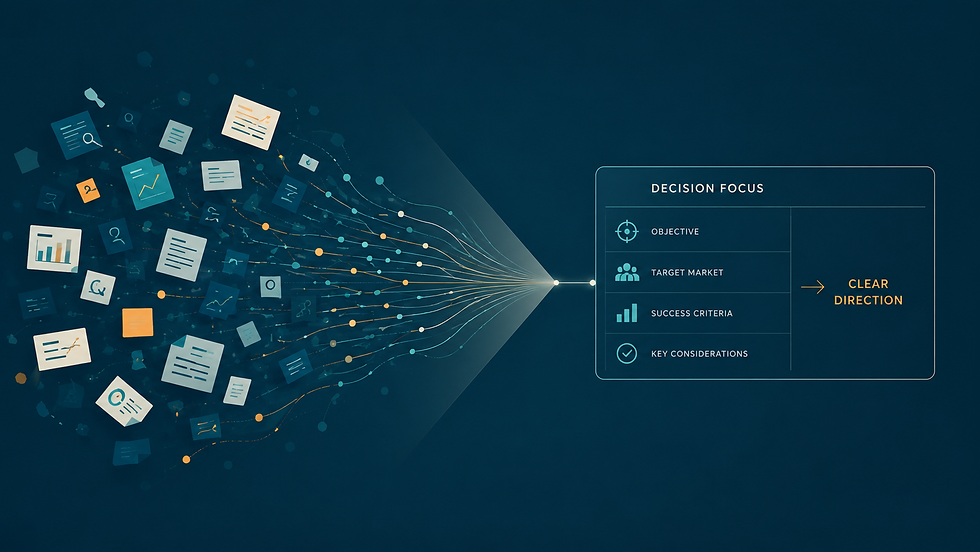
With the decision clearly defined, the next phase of the project could begin. Contrary to popular belief, this is not the stage where answers immediately appear. In fact, the early stages of a market intelligence project often create more questions than conclusions. The objective is not to find evidence that supports a desired outcome. The objective is to understand what the market is actually communicating through a collection of independent signals.
The first signals came from demand. Search activity suggested that people were actively looking for solutions related to the client's offering. At first glance, this appeared encouraging. However, demand alone rarely provides enough information to support a strategic decision. High search volumes can indicate curiosity, research behavior, or general awareness rather than genuine commercial intent. The challenge was not determining whether people were interested. The challenge was understanding whether that interest could realistically translate into customers.
The next layer involved examining the voice of the customer. Across reviews, discussion forums, industry communities, and public conversations, patterns began to emerge. Customers repeatedly described similar frustrations, recurring needs, and expectations that existing solutions were not always meeting. These conversations often revealed insights that could not be found in industry reports or market forecasts. They provided a direct view into the experiences and priorities of the people the client hoped to serve.
Attention then shifted toward competitors. The goal was not simply to identify who was operating in the market. It was to understand how they were positioned, how they acquired customers, and what advantages they possessed. Some competitors appeared stronger than expected. Others seemed highly visible but less differentiated upon closer examination. Certain companies dominated specific segments while leaving opportunities open in others. As the analysis expanded, the competitive landscape became more nuanced than the client had initially assumed.
Markets often appear attractive until maturity, saturation, and competitive concentration begin limiting growth opportunities.
At the same time, broader market conditions were evaluated. Industry growth, accessibility, customer acquisition challenges, pricing expectations, and operational considerations all contributed additional context. Individually, each signal provided only a partial view of reality. Together, they began forming a more complete picture. Some observations reinforced one another. Others introduced contradictions that required further investigation. This process of comparison and validation proved just as important as the original data collection itself.
As the research progressed, something interesting began to happen. Independent sources that had been analyzed separately started pointing toward similar conclusions. Demand signals aligned with customer conversations. Competitive observations aligned with market dynamics. What initially appeared to be a collection of disconnected data points gradually evolved into a coherent narrative. The market was beginning to reveal not just what was happening, but why it was happening.
This is where meaningful market intelligence starts to emerge. Valuable decisions are rarely built on a single statistic, report, or trend. They are built when multiple independent signals tell the same story. The role of research is not to collect information. It is to identify patterns strong enough to support a decision with confidence.

The Turning Point
As the research progressed, the project reached a stage that often determines the value of the entire process. Up until this point, information had been gathered, patterns had been identified, and assumptions had been tested against evidence. Yet no recommendation had been made. The objective was still not to reach a conclusion as quickly as possible. The objective was to understand whether the different pieces of evidence could withstand closer scrutiny.
This is the stage where many opportunities either strengthen or begin to unravel. It is also the stage where initial impressions are most likely to be challenged. Markets that appear attractive on the surface sometimes reveal barriers that were previously hidden. Demand that seems strong can prove difficult to monetize. Competitors that appear vulnerable can turn out to possess advantages that are difficult to overcome. In many projects, this is the point where confidence begins to decline as complexity becomes more visible.
In this particular case, the opposite occurred.
The deeper the analysis became, the more consistency emerged across independent sources of information. Demand signals continued to point toward genuine customer interest.
Customer conversations reinforced the presence of unresolved needs. Competitive analysis revealed active players but did not indicate insurmountable barriers to entry. Industry trends supported the view that the market was not experiencing temporary momentum but rather sustained development.
Most importantly, the findings were no longer operating in isolation. Individual observations that initially appeared unrelated began supporting one another. Customer frustrations aligned with identified market gaps. Search behavior aligned with emerging demand patterns. Competitive positioning aligned with opportunities for differentiation. Instead of producing contradictions, the evidence increasingly pointed toward the same conclusion.
At this stage, the discussion shifted. The question was no longer whether the market existed. The question was no longer whether demand was present. The conversation became focused on execution. What would be required to enter successfully? Which customer segments should be prioritized? How should positioning be approached? What risks would need to be managed during implementation?
This shift may appear subtle, but it represents one of the most important moments in any market intelligence project. A business moves from asking whether an opportunity is real to asking how that opportunity can be captured. The uncertainty has not disappeared. No research process can eliminate uncertainty entirely. However, uncertainty has been reduced to a level where strategic planning becomes possible.
This is often the true value of market intelligence. It does not create opportunities that did not previously exist. It helps determine whether the opportunities already being considered deserve action, investment, and commitment. When multiple independent signals continue pointing in the same direction after rigorous examination, confidence becomes grounded in evidence rather than optimism.

The Recommendation
By the time the analysis reached its final stages, the objective was no longer to gather additional information. The objective was to determine whether enough evidence existed to support a strategic recommendation. This distinction is important because market intelligence does not create value through the volume of information collected. Its value comes from helping decision makers move forward with greater confidence and a clearer understanding of both opportunities and risks.
At the beginning of the project, the client arrived with optimism, but also with uncertainty. There were reasons to believe the opportunity was attractive, yet there were also unanswered questions that made committing resources difficult. The purpose of the research was never to prove the client right or wrong. It was to establish whether the assumptions behind the opportunity could withstand objective examination.
As the various layers of analysis came together, a consistent picture emerged. Demand appeared genuine rather than temporary. Customer conversations revealed needs that were not being fully addressed by existing solutions. Competitive conditions presented challenges, but not barriers that would prevent entry. Industry dynamics supported the possibility of sustainable growth rather than short term momentum. Most importantly, the different sources of information continued reinforcing one another rather than creating contradictions.
The recommendation was therefore clear.
Proceed.
Not every decision carries the same level of strategic importance, which is why the recommendation process focused on consequences rather than information alone.
Not because a single report predicted growth. Not because search volumes looked attractive. Not because competitors already existed in the market. The recommendation was based on the fact that multiple independent forms of evidence pointed toward the same conclusion. The opportunity appeared real, accessible, and commercially viable under realistic assumptions.
That recommendation did not guarantee success. No responsible research process can offer guarantees. Markets evolve, competitors respond, customer behavior changes, and execution always plays a critical role. However, the analysis provided something equally valuable. It transformed uncertainty from an unknown risk into a manageable one.
For the client, the outcome was not simply a report or a collection of findings. The outcome was confidence. Confidence to allocate resources. Confidence to move forward with planning. Confidence to make decisions based on evidence rather than instinct alone.
This is ultimately the purpose of market intelligence. Businesses rarely struggle because information is unavailable. In today's world, information is abundant. The real challenge is determining which information matters, how different signals connect, and what actions should follow. Effective market intelligence bridges the gap between data and decisions. It does not eliminate uncertainty, but it reduces uncertainty enough to allow better decisions to be made.
When a business reaches that point, research has achieved its true purpose. Not by describing a market, but by helping leaders decide what to do next.

The Lesson
Every market intelligence project begins with a market, but it rarely ends there.
At the start of this project, the client believed the challenge was understanding an opportunity. Like many businesses facing an important decision, the assumption was that more information would naturally lead to greater clarity. The expectation was that research would reveal whether the market was attractive and whether expansion made sense.
What ultimately emerged was something different.
The most valuable insights did not come from any single report, trend, or dataset. They emerged from the process of connecting multiple sources of evidence and evaluating them against a specific decision. Demand, customer conversations, competitive dynamics, market conditions, and business realities each provided only part of the picture. Meaningful conclusions became possible only when those pieces were examined together.
This experience highlights a common misconception about market research. Many organizations approach research as an exercise in information gathering. They focus on collecting data, generating reports, and building dashboards. While these activities can be useful, they do not automatically improve decision quality. Information becomes valuable only when it helps reduce uncertainty around an important choice.
The purpose of market intelligence is not to predict the future with certainty. No methodology, tool, or analyst can eliminate risk entirely. Markets change, customer behavior evolves, and unexpected developments occur in every industry. The objective is not certainty. The objective is confidence grounded in evidence.
In this case, the client did not receive a guarantee of success. What they received was something far more practical. They gained a clearer understanding of the opportunity, a realistic view of the risks, and a stronger foundation for making strategic decisions. Instead of moving forward based solely on optimism, they moved forward with a structured understanding of why the opportunity appeared viable and what would be required to capture it.
That is the difference between collecting information and generating intelligence.
Information describes what is happening.
Intelligence helps determine what to do next.
For businesses operating in competitive and uncertain environments, that distinction often becomes the difference between reacting to the market and making decisions with purpose.
And that is where meaningful market intelligence begins.
Beyond the Project
The recommendation marked the end of the research project, but it did not mark the end of the decision-making process. In many ways, it represented the beginning of a new phase. Research can reduce uncertainty, reveal opportunities, and expose risks, but the market itself continues to evolve long after a report has been delivered. Customer expectations change, competitors adapt, new technologies emerge, and economic conditions shift. A decision that is well supported today must still be monitored and refined over time.
This is why effective market intelligence should never be viewed as a one-time exercise. The most successful organizations treat it as an ongoing capability rather than a single project. They continuously observe the signals that matter, revisit key assumptions, and remain willing to challenge conclusions when new evidence emerges. The goal is not to become attached to a particular strategy. The goal is to remain aligned with reality as that reality changes.
For the client in this project, the value extended beyond the immediate recommendation. The process provided a framework for evaluating future opportunities. The same principles used to assess this market could be applied to new products, additional customer segments, geographic expansion, partnerships, and investment decisions. What began as a question about one opportunity ultimately became a better approach to decision-making itself.
This is often the most overlooked outcome of a market intelligence project. While businesses typically seek answers, the greatest value frequently comes from gaining a better way to ask questions. Strong decisions rarely depend on perfect information. They depend on understanding which uncertainties matter most, which assumptions require validation, and which signals deserve attention.
The companies that consistently make better strategic decisions are not necessarily those with the largest budgets, the most data, or the most sophisticated technology. More often, they are the organizations that have developed a disciplined process for turning information into action. They understand that intelligence is not measured by the amount of data collected, but by the quality of the decisions that follow.
Ultimately, every market intelligence project seeks to answer a practical question: what should we do next? The answer is rarely found in a single chart, report, or statistic. It emerges through a structured process of observation, analysis, validation, and interpretation. When that process is done well, businesses gain something more valuable than information. They gain the confidence to move forward with purpose.
Why This Process Matters More Than Ever
The modern business environment has created an unusual paradox. Organizations have access to more information than at any point in history, yet many decision makers feel less certain about their choices than ever before. Reports are readily available. Market data can be obtained within minutes. Competitive information is easier to access than it has ever been. Artificial intelligence can generate summaries, forecasts, and recommendations almost instantly.
Despite this abundance of information, uncertainty remains.
In many cases, uncertainty has actually increased.
The reason is simple. Information alone does not create understanding.
Access to data does not automatically produce clarity. When decision makers are exposed to dozens of reports, conflicting opinions, competing forecasts, and endless streams of new information, determining what truly matters becomes increasingly difficult. The challenge is no longer finding information. The challenge is identifying which information deserves attention and how different pieces of evidence should be interpreted together.
This reality is changing the role of market intelligence. Historically, research was often viewed as a process of gathering information that was otherwise difficult to obtain. Today, information itself is rarely the primary constraint. What businesses increasingly need is interpretation, validation, prioritization, and context. They need a structured process that transforms scattered observations into actionable insight.
This is why the methodology behind the research matters as much as the information itself. Two organizations may have access to exactly the same data and still arrive at completely different conclusions. The difference often lies not in what they know, but in how they evaluate evidence, challenge assumptions, and connect individual findings into a coherent strategic picture.
The project described throughout this article reflects that principle. The value did not emerge from a single source, tool, or dataset. It emerged from the ability to evaluate multiple signals together, identify meaningful patterns, and determine whether the evidence supported action. The recommendation was ultimately a result of disciplined thinking rather than information alone.
As markets become more competitive and change accelerates across industries, this capability becomes increasingly valuable. Businesses that can consistently transform uncertainty into informed decisions gain a significant advantage over those that rely solely on intuition, isolated metrics, or incomplete information.
In the end, market intelligence is not about knowing everything.
It is about knowing enough to move forward intelligently.
And in a world where uncertainty can never be fully eliminated, that may be one of the most valuable capabilities a business can develop.
Final Thoughts
Every important business decision begins with uncertainty.
Whether the decision involves entering a new market, launching a product, expanding operations, investing resources, or pursuing a new opportunity, there is always a moment when leaders must decide before having complete certainty. Waiting for perfect information is rarely possible. Acting without sufficient understanding can be equally dangerous.
The purpose of market intelligence is not to remove uncertainty entirely. No research process can achieve that. Its purpose is to replace assumptions with evidence, transform questions into structured analysis, and provide decision makers with a clearer understanding of the reality they are facing.
The project described throughout this article was ultimately not about a market. It was about a decision.
The market provided the context.
The research provided the evidence.
The analysis provided perspective.
The recommendation provided direction.
Together, they allowed a business to move forward with greater confidence than would have been possible through intuition alone.
This is the value of decision focused market intelligence.
Not more data.
Not more reports.
Not more dashboards.
Better decisions.
Because in the end, businesses are not defined by the information they collect.
They are defined by the decisions they make.
Further Reading
To understand how YNALIZE turns market information into decision focused intelligence, explore our full methodology.


Comments