
What AI Still Cannot Tell You About a Market
Updated: Sep 3

What AI Still Cannot Tell You About a Market
Artificial intelligence has fundamentally changed the way businesses approach market research.
Tasks that once required days of manual work can now be completed within minutes. AI can summarize industries, identify competitors, estimate market size, organize customer feedback, analyze search demand, compare business models, and generate strategic recommendations with remarkable speed. For many organizations, it has transformed research from a slow and expensive process into something that is accessible almost instantly.
This shift is significant. It has lowered the barrier to information and allowed businesses of every size to access knowledge that was once available only to specialized research teams. A founder exploring a new opportunity, a product manager evaluating customer demand, or an executive assessing market conditions can now begin their research with a single prompt.
But as impressive as these capabilities are, they also create a dangerous illusion.
When information becomes easier to obtain, it is tempting to believe that better decisions naturally follow. If AI can analyze thousands of documents in seconds, summarize hundreds of customer reviews, compare dozens of competitors, and identify emerging trends, then surely it should also be able to determine whether entering a market is the right decision.
This assumption is understandable.
It is also incomplete.
Because while AI has dramatically improved our ability to process information, markets are not made of information alone.
Markets are made of people.
They are shaped by incentives, relationships, timing, trust, negotiation, uncertainty, and countless decisions that never become part of any public dataset.
This distinction matters more than ever.
The challenge facing modern businesses is no longer how to access information. That problem has largely been solved. The new challenge is understanding where information ends and judgment begins.
And that may be the most important question in market intelligence today.
AI Has Changed Research. But It Has Not Changed Markets.
Artificial intelligence has undoubtedly transformed the research process. Information that once required hours of searching across reports, websites, databases, and public sources can now be gathered and organized within minutes. Competitive landscapes can be mapped more quickly, industry trends summarized more efficiently, and large volumes of publicly available information analyzed at a scale that would have been difficult for most organizations only a few years ago.
This shift should not be underestimated.
For the first time, access to information is no longer the primary competitive advantage it once was. The ability to retrieve facts, summarize documents, identify patterns, and generate structured overviews has become widely available. In many respects, AI has democratized research by making sophisticated analytical capabilities accessible to organizations of every size.
However, while the process of conducting research has changed dramatically, the nature of markets has not.
Businesses still compete for trust.
Customers still make emotional as well as rational decisions.
Partnerships continue to depend on relationships.
Pricing is still influenced by negotiation rather than theory.
Competitive advantages are often built on execution rather than visibility.
None of these realities have disappeared simply because information has become easier to access.
This creates an important distinction that is often overlooked.
AI excels at organizing what is already visible.
Markets are influenced by what is often invisible.
A company's public messaging may suggest confidence while internal performance is deteriorating. Customer reviews may appear overwhelmingly positive while long-term retention continues to decline. Search demand may indicate growing interest even as purchasing behavior shifts toward entirely different solutions. Two businesses can present remarkably similar public profiles while operating under completely different commercial realities.
The challenge is not that AI misunderstands markets.
The challenge is that markets contain layers of information that are never published, never measured, and sometimes never even consciously recognized by the people participating in them.
Understanding where those invisible layers begin is what separates information gathering from market intelligence.

The Market That Exists Only on Paper
One of the greatest strengths of artificial intelligence is its ability to analyze published information.
It can read company websites, industry reports, news articles, financial statements, customer reviews, search trends, and thousands of other publicly available sources in a matter of seconds. It can organize this information into structured summaries and identify relationships that would take human researchers significantly longer to uncover.
Yet there is an important question that rarely receives enough attention.
What if the market described by public information is not the market businesses actually experience?
Every market has two versions.
The first is the visible market.
It is the market that appears in reports, websites, search results, presentations, press releases, investor updates, product pages, and industry statistics. It is measurable, searchable, and increasingly accessible through artificial intelligence.
The second is the operational market.
This is where purchasing decisions are delayed because budgets suddenly disappear. It is where distributors quietly recommend one supplier over another. It is where customers remain loyal for reasons that never appear in product reviews. It is where procurement teams reject solutions because of internal policies rather than product quality. It is where long-standing relationships influence outcomes more than pricing models.
Very little of this market is publicly documented.
Yet it often determines who succeeds and who fails.
Two companies may appear almost identical when viewed through publicly available information. Both have similar products, similar pricing, comparable marketing, and positive customer feedback. An AI system analyzing those companies may conclude that they occupy similar competitive positions.
In reality, one company may have spent years building trusted relationships with distributors. The other may rely almost entirely on paid customer acquisition. One may enjoy exceptionally high customer retention because of operational excellence. The other may struggle with profitability despite rapid growth.
From the outside, they appear similar.
Inside the market, they are fundamentally different.
This distinction illustrates one of the most important limitations of AI in market intelligence.
Artificial intelligence is exceptionally good at analyzing published reality.
Business decisions, however, often depend on operational reality.
And those two realities are not always the same.

Facts Rarely Make Decisions
One of the most common assumptions about artificial intelligence is that better information naturally leads to better decisions.
On the surface, the logic seems difficult to challenge. If an AI system can gather more information, analyze more variables, compare more competitors, and identify more patterns than any individual researcher, then its conclusions should also be more reliable.
But business decisions rarely fail because the facts were wrong.
They fail because the facts were interpreted within the wrong context.
A market can genuinely be growing.
Customer demand can genuinely exist.
Competitors can genuinely be successful.
Industry forecasts can genuinely be optimistic.
None of these statements are necessarily false.
The problem is that they do not answer the same question.
Imagine two companies reviewing exactly the same market.
Both analyze the same competitors.
Both examine the same customer demand.
Both read the same industry reports.
Both use the same AI tools.
One decides to enter the market.
The other decides not to.
At first, this appears contradictory.
In reality, both decisions may be correct.
The difference lies not in the information they collected, but in the business they are trying to build.
One company may possess distribution capabilities that dramatically reduce customer acquisition costs.
The other may depend entirely on expensive paid marketing.
One may already have trusted relationships with enterprise buyers.
The other may be completely unknown.
One may require rapid profitability.
The other may be willing to invest for years before generating meaningful returns.
The market has not changed.
The decision has.
This is where the limits of information become visible.
Information describes the environment.
Decisions depend on context.
Artificial intelligence can become increasingly effective at explaining what is happening around a business.
Only the business itself can determine what those facts actually mean for its own strategy, capabilities, constraints, and objectives.
That is why two companies can look at the same market and reach completely different conclusions without either of them being wrong.
The market provides information.
The business provides context.
Only when the two are considered together does meaningful decision making become possible.
The Questions That Matter Are Often the Ones No Dataset Can Answer
Every research project eventually reaches a point where the available information appears sufficient.
The reports have been reviewed.
Competitors have been analyzed.
Customer feedback has been summarized.
Demand has been measured.
Industry trends have been mapped.
At this stage, it is tempting to believe that the remaining task is simply to choose the best option.
In reality, this is often where the most important questions begin.
Not because more information is needed.
But because the questions themselves have changed.
The early stages of research are largely descriptive.
What is the market size?
Who are the competitors?
How fast is the industry growing?
What are customers saying?
These questions help describe the environment.
Strategic decisions, however, require a different type of question.
Why do customers continue buying from companies they openly criticize?
Why does one competitor consistently outperform businesses offering similar products?
Why does a market with growing demand remain difficult to enter?
Why do some businesses succeed despite appearing weaker than their competitors?
These questions rarely have a single measurable answer.
They require interpretation.
They require judgment.
Most importantly, they require an understanding that not every important business variable can be observed directly.
Some of the strongest competitive advantages exist precisely because they are difficult to measure.
Trust.
Execution.
Relationships.
Internal capabilities.
Organizational culture.
Speed of adaptation.
These are often the forces shaping markets behind the scenes.
They rarely appear in a spreadsheet.
They are seldom captured in a public database.
Yet they frequently determine the outcome of strategic decisions.
This is where the role of market intelligence changes.
The objective is no longer to collect additional facts.
The objective becomes identifying which unanswered questions still matter enough to influence the decision.
Because in many cases, the quality of a decision depends less on the amount of information available than on the quality of the questions that remain unanswered.
The Future of Market Intelligence Is Not AI Versus Humans
The discussion surrounding artificial intelligence is often framed as a competition.
Will AI replace analysts?
Will AI replace consultants?
Will AI replace market researchers?
These questions are understandable, but they may also be asking the wrong thing.
Throughout history, transformative technologies have rarely eliminated the need for judgment. Instead, they have changed where judgment creates the greatest value.
Calculators did not eliminate mathematicians.
Spreadsheets did not eliminate financial analysts.
Search engines did not eliminate researchers.
Each innovation reduced the time required to gather and organize information. What remained valuable was the ability to interpret that information, question it, and transform it into decisions.
Artificial intelligence is following a similar path.
Its greatest contribution may not be replacing human thinking, but removing many of the mechanical tasks that once consumed it.
Researchers no longer need to spend days collecting publicly available information.
They can spend more time evaluating contradictions.
Testing assumptions.
Understanding context.
Identifying risks that are not immediately visible.
Asking better questions.
This represents a fundamental shift in the role of market intelligence.
The competitive advantage is gradually moving away from access to information.
It is moving toward the ability to distinguish between information that is merely interesting and information that is strategically significant.
In a world where almost everyone has access to similar tools, similar reports, and increasingly similar AI-generated summaries, the difference is unlikely to come from who gathers information first.
It will come from who interprets it better.
The organizations that consistently make better decisions will not necessarily be those using the most advanced artificial intelligence.
They will be the ones that combine technological capability with human judgment, critical thinking, and a disciplined decision-making process.
Because markets are ultimately shaped by people.
And understanding people has never been only a data problem.
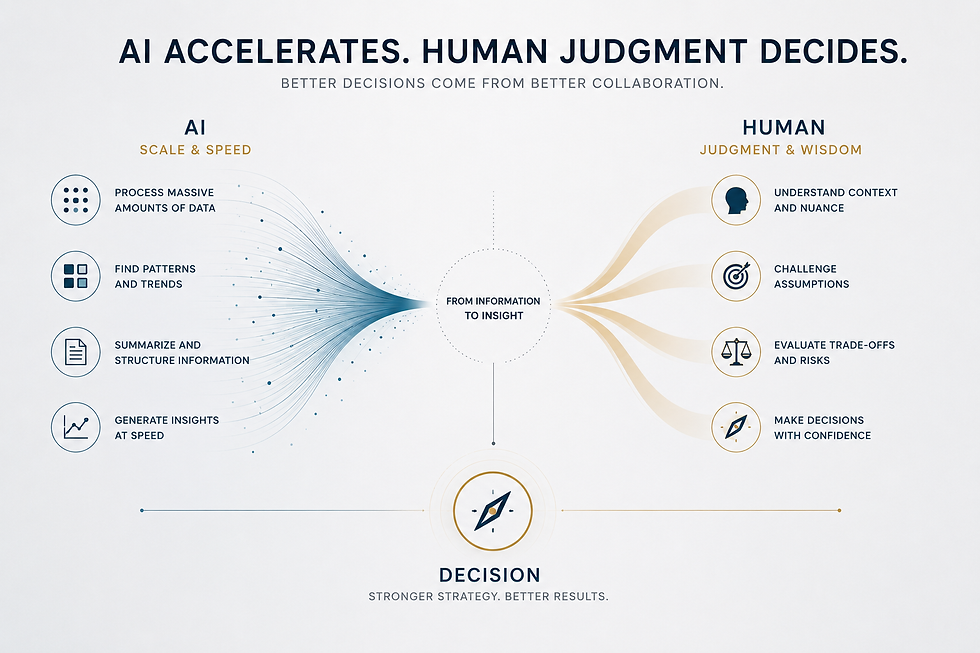
Perhaps the Wrong Question Was Never "What Can AI Do?"
Throughout the conversation surrounding artificial intelligence, one question dominates almost every discussion.
What can AI do?
It is a fascinating question.
But perhaps it is no longer the most important one.
Artificial intelligence is improving at an extraordinary pace. Every new generation expands its ability to analyze information, recognize patterns, summarize knowledge, and accelerate research.
The more interesting question is no longer what AI can do.
It is what businesses should do differently because AI exists.
When information becomes abundant, its value changes.
When everyone can generate similar reports, reports become less valuable.
When every competitor has access to similar tools, technology alone stops being a competitive advantage.
The scarce resource is no longer information.
It is judgment.
The ability to recognize weak signals before they become obvious.
The discipline to challenge assumptions that appear convincing.
The experience to distinguish between patterns that matter and patterns that merely look persuasive.
The confidence to make decisions without waiting for perfect certainty.
Artificial intelligence will almost certainly continue becoming better at answering questions.
The organizations that succeed will be those that become better at asking them.
Because markets rarely reward those who possess the most information.
They reward those who make the best decisions with the information available.
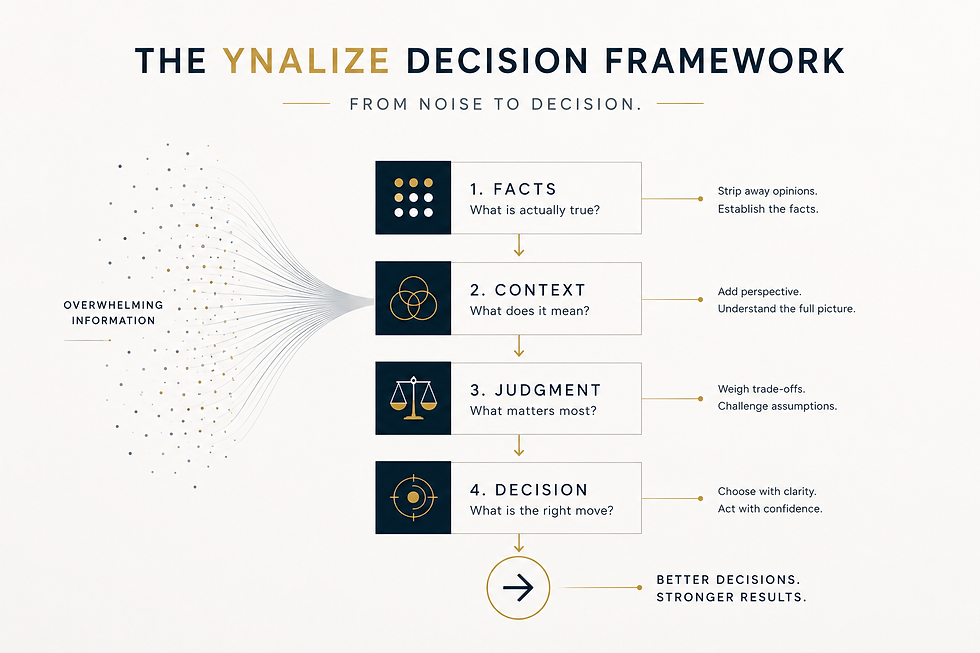
Market intelligence has never been about knowing more. It has always been about deciding better.


Comments